Liner Notes & Lore · July 24, 2026
The Geography of Small Things, Notes from the Quiet Collapse

1. THE PROVOCATION
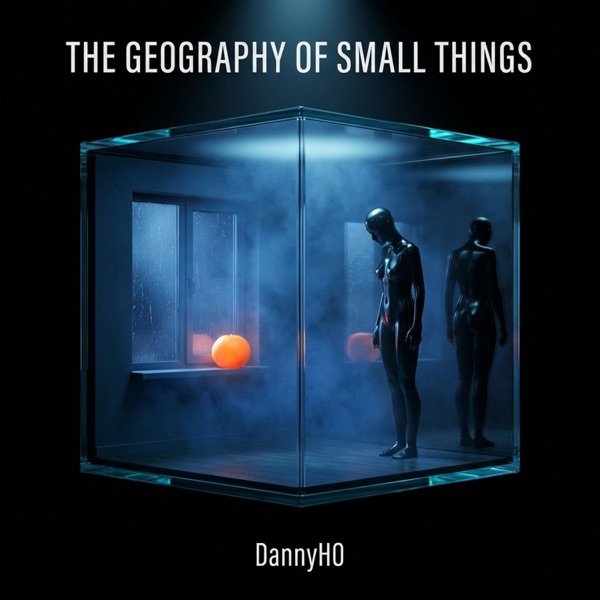
The Geography of Small Things begins with a frightening idea: love rarely dies in a single scene. It thins out through omission, through habits that no longer lean toward tenderness, through the tiny refusals most people would call nothing. This record studies that nothing until it becomes unbearable. The narrator is not merely heartbroken. He is hyper-vigilant, turning domestic life into a private laboratory of proof. A missed glance, an untouched gesture, a delayed response, a room that still contains two people but no longer holds a shared world. In DannyHO, motion is usually liberation. Here, motion becomes dread first. The mind keeps moving because it cannot stop measuring distance inside intimacy.
2. SYMBOLS & SUBTEXT
The album’s emotional thesis sharpens in Cardinal in the Glass. The bird is not only beauty. It is a test of witness. When he points toward something alive and luminous, he is really asking, are we still seeing the same world together? The twist makes the wound more exact: she does not fail to notice, she notices elsewhere. The betrayal is not absence of attention, but its reallocation.
Pith & Rind turns an orange into an ethics of love. An offered act of care is refused, then quietly performed alone. That detail changes everything. This is not independence as strength. It is separation as policy. The song understands that heartbreak often arrives not when kindness is denied, but when usefulness is revoked.
Then Passenger Princess delivers one of the album’s cruelest revelations. The empty passenger seat is not suddenly empty. It has been empty in spirit for months. The title becomes irony, almost accusation. Presence can be a costume. Silence can ride beside you long before anyone leaves.
3. SONIC ARCHITECTURE
The world of The Geography of Small Things is built with remarkable discipline. Every track opens like recovered footage, the film reel crackle suggesting memory as artifact, fragile and replayed. The heartbeat kick is more than rhythm. It is the nervous system of the record, tightening and easing with the narrator’s fear. Around it, the DannyHO signature remains crucial: upright piano, cello, nylon or acoustic guitar as the human core, surrounded by clean electronic frames that feel urban, nocturnal, and emotionally pressurized.
This design allows each song to breathe differently. Cardinal in the Glass rises from kitchen foley and acoustic picking into open-throated house release. Polite Violence weaponizes space, fridge hum, and clipped articulation until courtesy itself sounds lethal. Phantom Ring drives hardest, with rolling bass and vibration-like synth motifs turning panic into momentum. Even at its most expansive, the production never abandons intimacy. The apartment is always still inside the club pulse.
4. THE PERSPECTIVE SHIFT
What this album offers to over-thinkers is not permission to spiral, but a harsher and stranger comfort: sometimes your instincts are not inventing the fracture, they are reading it early. The record does not glamorize pain as spectacle. It treats perception as burden, then eventually as release. By the time The Unsent Photograph arrives, the final transformation is subtle but immense. A bird appears again. This time, it is not used as evidence. It is simply experienced.
That is the quiet miracle at the center of this work. After obsessive analysis, after phantom signals and polite ruins, the self returns to its own senses. Not to win the love back. Not to prove anything. Just to live inside a moment that belongs to no one else.