Liner Notes & Lore · September 5, 2026
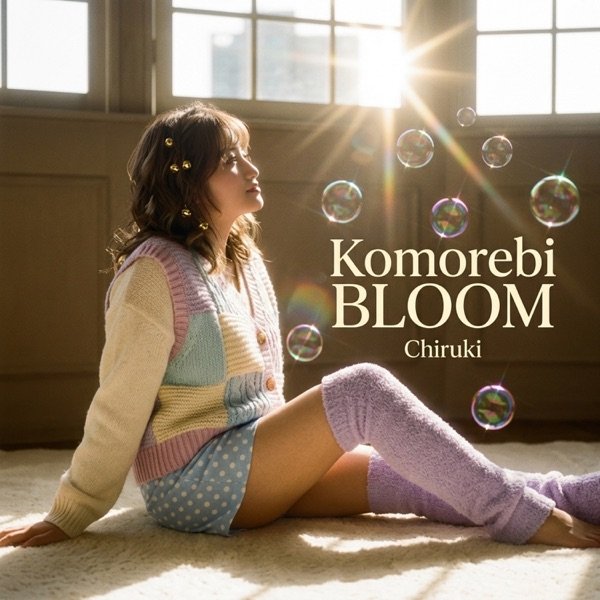
The Soft Rebellion of Chiruki’s Komorebi BLOOM

1. THE PROVOCATION
Chiruki’s Komorebi BLOOM opens on the first morning after a long, grey goodbye. The house is not empty with sorrow; it is light with possibility. The record’s premise inverts the usual breakup narrative. Instead of asking how to survive loss, it asks what happens when you realize the heaviness you carried was never a broken heart, but the weight of a mismatched, unappreciative partner. The protagonist rehearsed being heartbroken in her sleep, only to wake and discover that making one piece of toast feels like liberation. This is not a revenge album. It is a soft, cozy reclamation of daily life.
2. SYMBOLS & SUBTEXT
In ‘Shabondama TEARS’, the soap bubble becomes the central symbol. Grief is not a heavy stone; it is a thin, iridescent film that pops with a small, bright sound. The key lyric, ‘シュワパチ弾けるシャボン玉’, turns tears into effervescent play. The twist is quietly devastating: he said his memories would weigh her down forever, but she packs them all into one very small cardboard box and laughs at how light it is. In ‘Yurushi no RECIPE’, the cake functions as a measure of self-worth. She was never bad at baking. The missing ingredient was simply a kitchen without his sighs in it. Forgiveness here is not about excusing him; it is about reclaiming the act from the failure he projected onto her. ‘Gyakuten POCKET’ goes further. A ticket stub from a terrible date is not thrown away. It is repurposed as a bookmark in a happy fairy tale, literally rewriting the memory’s function. The past becomes paper, thin enough to press between pages.
3. SONIC ARCHITECTURE
The production refuses synthetic coldness. Felt piano, upright bass, clarinet, and bassoon provide an acoustic heartbeat. Over this organic bed, Chiruki layers toytronica: celesta, glockenspiel, toy piano, music box arpeggios. The result is a clean, warm world that feels handmade. Vocal textures shift with each song’s emotional weather. In ‘Akatsuki COLOR’, close-mic intimacy in the verses blooms into a bright, smiling head voice. ‘Step Up KUTSU-SHITA’ is cheeky and bouncy, with pizzicato strings and floorboard-like percussion. ‘Hoshi-kuzu CASTLE’ uses heavy reverb to place the whisper-pop vocal inside an infinitely large blanket fort. Even the drops avoid synthetic markers, relying instead on layered kawaii-pop synths and bright melodies. This is dance music for a sun-drenched living room, not a cyberpunk club.
4. THE PERSPECTIVE SHIFT
The record challenges the listener to stop equating healing with dramatic catharsis or bitter closure. It proposes that recovery can look like dancing alone in fuzzy socks, baking a perfect cake, stringing fairy lights, and leaving the front door metaphorically open because you have grown an indoor garden too dense for heavy boots to enter. The ex in ‘Hitori-botchi CHEERS’ zooms into a photo searching for a second shadow, but she has not replaced him with a man. She has replaced him with profound inner peace. By the final track, ‘Ashita he BLOOM’, his text, ‘hope you find peace’, arrives too late. She did not find peace. She cultivated an entire paradise. Komorebi BLOOM expands the listener’s idea of strength. It can be soft, pastel, domestic, and absolutely unbreakable.