Liner Notes & Lore · June 4, 2026
KÓDIGO FOLKLÓRIKO: The Body Remembers

1. THE PROVOCATION
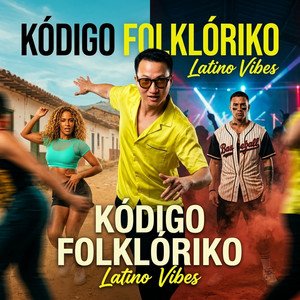
KÓDIGO FOLKLÓRIKO begins with a refusal: tradition will not sit behind glass. In the world this record builds, roots are not fragile relics awaiting preservation. They are pressure, repetition, muscle memory, the impulse that reaches the feet before the mind can name it. Latino Vibes imagines the Dancer as an avatar of modern Latin youth, carrying ancestral pride into the warehouse, the workout, the street, and the late night set. The album’s central argument is physical and unapologetic. Cultural memory survives because bodies keep moving.
2. SYMBOLS & SUBTEXT
“GUAJIRA TEK” makes its thesis audible through friction. A jarana chord is granulated until it carries the abrasive force of a techno snare, while “Leather hitting pavement under neon skies” places rural string logic inside an urban nocturne. The transformation is not erasure. It is proof that an acoustic gesture can become new machinery without surrendering its pulse. On “PIKETONA RAVE,” merengue brass is forced into a hard 4/4 grid. Its tightly quantized attack dramatizes the tension between fluid inherited syncopation and the club’s uncompromising forward drive. “Emancipate the rhythm from its storage” becomes a demand to release culture from fixed ideas of purity. “GAITA EN PARIS” extends that demand across distance. Gaita and acid synth merge into a single instrument, while “Scrap the holy relics, give them to the heat” rejects reverence without use. The sacred, here, is what can still ignite a room.
3. SONIC ARCHITECTURE
This album is engineered as continuous DJ logic, where traditional materials behave with synthetic discipline. Gaita flutes, accordion chops, tambora, guacharaca, brass, harp, piano montuno, and bachata guitar are held strictly on the grid, deployed as sharp stabs, loops, and release points. Beneath them, 4/4 Latin house and heavy dembow frameworks establish the floor. Micro drops do not depend on clutter. They create impact by stripping the arrangement to kick, sub bass, breath, or a single cut of percussion. “KUMBIA BASS” sinks a wooden flute melody into distorted low end, turning melody into chest pressure. “BELLAKO FÍSIKO” brings the body directly into the drum machine through skin slaps, breaths, wood, and cajón. Across the record, chopped Spanglish commands, whispers, sighs, hums, and collective chants function less as narrative lyrics than as rhythmic signals. The voice becomes another limb in the groove.
4. THE PERSPECTIVE SHIFT
The record asks listeners to stop treating modernity and lineage as opposing forces. Its ancestral rhythm does not travel from pueblo to rave as a souvenir. It arrives as a living code, altered by subwoofers, digital processing, sweat, and collective motion. For diaspora listeners, DJs, dancers, and creators, that code offers a direct language beyond explanation. “TIERRA KULT” resolves the argument in a crowd chant transformed into a futuristic choir: memory becomes communal because it is shared in real time. KÓDIGO FOLKLÓRIKO proposes that the dancefloor can be both archive and future, a place where movement does not merely celebrate identity. It actively keeps identity alive.