Album Story · November 11, 2026
The Clocks Melt Across NOVA RAY’s STRATOSPHERE
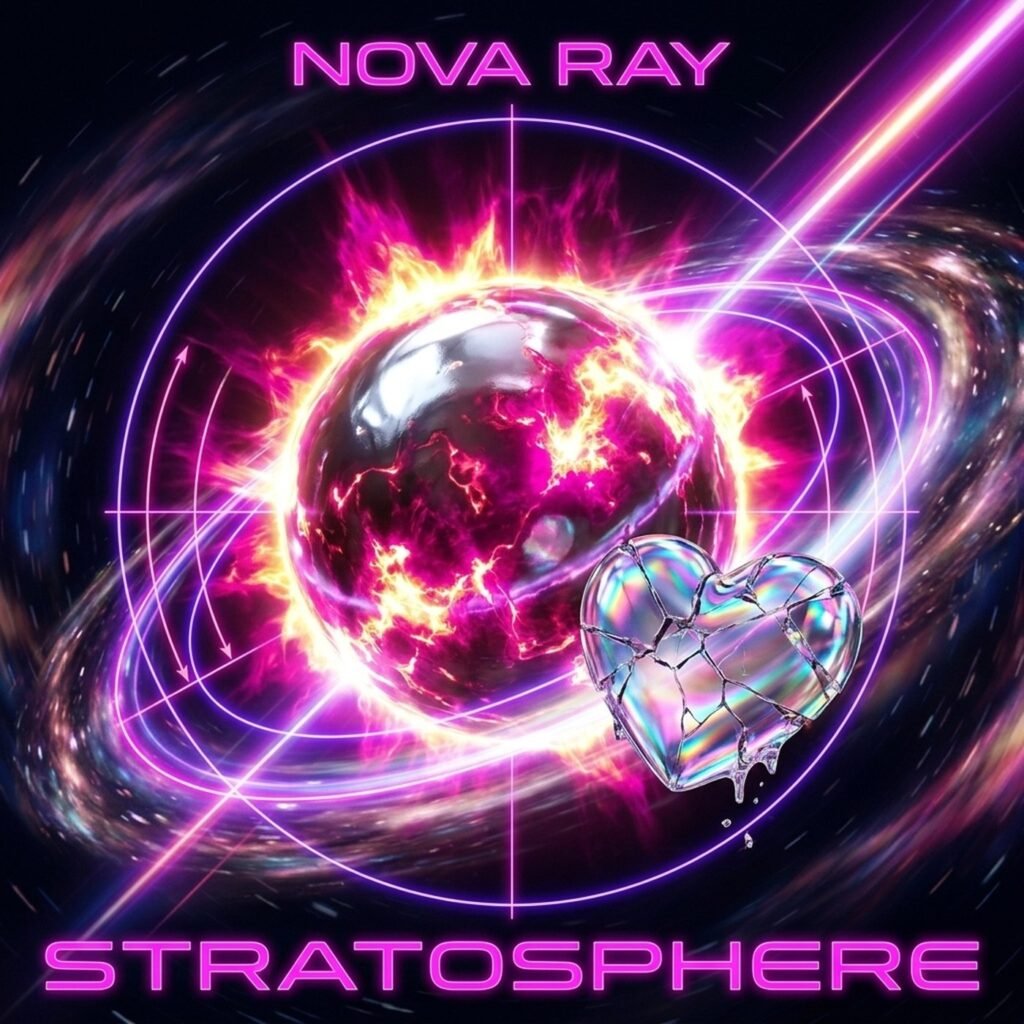
At 5:12 PM the ocean pulls away from the black rocks and leaves a long silver table of wet stone. She stands at its edge, not surprised by the wall of weather gathering past the horizon. STRATOSPHERE, the new concept album from NOVA RAY, opens in that exact posture: the heartbreak is enormous, visible for miles, and she walks straight into the bay with her anchor in her arms.
5:12 PM, the water gives her a head start
“Tidal Wave” begins with a massive acoustic piano, wide enough to hold the whole sky, before sidechain-compressed floor-toms start shoving air through the speakers. The chorus hits with a wall of synthetic strings and a chest-belt that arrives without apology. She is not caught off guard. She personally hauled her anchor to the center of the bay so the flood would know exactly where to drag her under. “Barefoot on the trembling coastal slate” is both the first image and the thesis: the damage is already picked out, and she wants the full weight of it.
Then the light thins into paper. “Paper Tiger” runs on fast acoustic guitar loops, claps, and stomps, small organic machines whirring before the stadium chorus opens its mouth. The lover is weak, his growl is straw, and she responds by filing his teeth until he can finally hurt her. The kick patterns stay around the dance-pop sweet spot, but the sentiment is far older than the synths.
9:47 PM, the house begins to lean
By mid-evening the fiction starts to crack. “Faultline” rides a bouncing Nu-Disco bassline made from processed wooden marimbas and low analog synthesizers, with pounding kicks and high-frequency shaker loops. The house sits over a split in the earth, and instead of reinforcing the beams, she removes them to make the eventual collapse more dramatic. Her breathy, rhythmically fast head-voice sounds almost conversational, which makes the sky-high sustained hook feel like a deliberate betrayal of calm.
“Category Five” tears through at 135 BPM. Sweeping white noise effects mirror the wind, rapid synth-string arpeggios slice over a crushing low end, and the verse is nearly spoken-word, cold and detached. The hurricane is not weather. She conjured it with her grief to barricade the roads so he cannot leave. What begins as euphoric chase has already turned into a hostage situation, and the production keeps accelerating because stopping would require her to feel the cost.
12:40 AM, the floor fills with static
The record’s center is a study in what happens when the body runs out of air. In “Combustion” a relentless synth-bass throb sits under a pounding tribal beat, and the pre-chorus crackles with distortion like popping timber. She catches fire knowing he likes to watch things burn, douses herself in invisible oil, steps into his sightline. The chorus drops into pure sonic overload, compressed and blinding, while the verses stay parched with vocal fry.
Then “Barometric Drop” slams the tempo down. Heavy, deliberate stomping acoustic backbeat. Sub-bass throbs like a slowed heartbeat. Huge empty spaces between snare hits create an acoustic vacuum. The vocal is close, intimate, every breath captured, and the chorus does not go bright; it expands into a suffocating darkness. She is removing the oxygen so he cannot say goodbye. “Bleeding Sun” answers that silence with the brightest arrangement on the record, shimmering acoustic guitars, intense analog bass synths, maxed-out high frequencies that mimic staring directly at an eclipse. She wants the blindness. If his silhouette is scarred onto her retina, he can never leave the room.
3:15 AM, every clock is wrong
At the fragile hinge of the night, the album turns mechanical. “Vernal Equinox” uses clean, rhythmic organic synth plucks that mimic a ticking clock, panned claps, and an incredibly dense string arrangement. The verses are staccato and panicked, the chorus stretches syllables into soaring sustained notes. She attacks every clock in the room, terrified that the passage of one more hour will tip the scales back against her.
Frost on my lashes, pine shadows bend
The pull quote lands in “Magnetic North”, a track built from stomping cavernous percussion, sub-frequencies, and metallic crystalline chimes that sound like cracking ice. She knows the compass is dragging her under the frozen lake, so she swallows the needle to fall faster. In “Blind Horizon”, arpeggiated woodwinds run through relentless four-on-the-floor kicks, a perpetual motion engine for a chase where the other person has never moved. The verses are dry and fatigued; the chorus demands extreme breath control, stacking notes until the mirage briefly looks solid.
5:02 AM, no warmth arrives
By the time the sky starts to pale, the room has emptied and the cold has done its work. “Whiteout” repurposes deep 808-style trap kicks through organic bass tones, slows the BPM, and hangs crystalline bell synths over massive syncopation. Her tears freeze her feet to the crowded dancefloor, anchoring her to the disco tiles so he cannot ignore her. The verse is breathy and highly rhythmic, almost a rapping cadence, before it erupts into a heartbreaking held chorus. “Apex” closes the night with the peak of Swedish-pop maximalism: an overdriven synth hook played by massive brass ensembles, an immense stadium acoustic stomp, and melismatic wailing that pushes past pristine technique into sheer exhausted devotion.
She is still there when the first light reaches the floor. The sun comes up without him, which is exactly why she stays burning in the upper atmosphere. Not as punishment. As proof.