Liner Notes & Lore · November 10, 2026
The Low End Keeps Every Promise the Lyrics Break
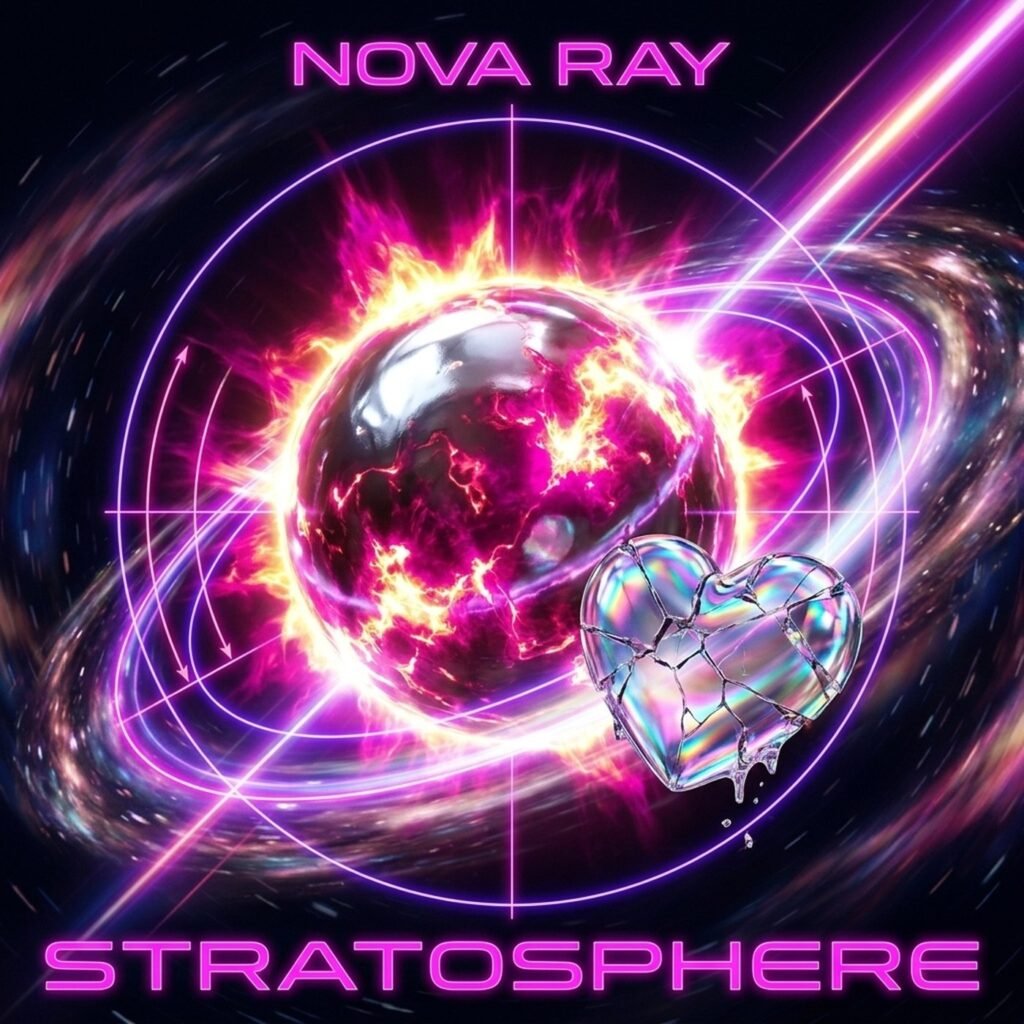
The Chord That Never Lands
NOVA RAY builds STRATOSPHERE on a harmonic trap. The vi-IV-I-V loop runs beneath the record like a pulse that never finds its own conclusion. The root chord is implied constantly and delivered nowhere. A standard Swedish pop arrangement would use this for forward motion, and it does. But under this album the unresolved cycle becomes something else: a formal refusal of safety. The kick drum, sidechain-compressed against the bass, pushes the body forward while the harmony remains suspended. Movement and stasis happen at the same time. The floor shakes and the chord never comes home.
This is not ornament. The production choices keep the listener in the exact state described by the lyrics: close enough to feel the heat, never close enough to touch the source. The 120 to 135 BPM range locks the songs into dancefloor territory, but the harmonic loop never allows the satisfaction the genre expects. It is a physical tension, not a thematic one. The bass frequencies throb under every chorus, and the synths rise in glossy layers, yet the final chord keeps slipping away.
The Sharpening of Paper
“Paper Tiger” wears its contradiction in the first line. The key lyric, “Your growl was straw, your shadow thin,” is delivered in a dry, raspy whisper, very close-mic, with the mouth’s small clicks intact. Fast acoustic guitar loops run under claps and stomps, a rhythm that sounds handmade, almost campfire-sized. Then the pre-chorus tightens and the chorus erupts with heavy analog bass pads and roaring organic synths. The arrangement follows the twist exactly: she finds him harmless, then files his teeth herself. The whispered verse is not confessing weakness. It is manufacturing ferocity in real time. By the time the chorus hits, the song has built a predator out of studio air.
What the production does is subtle and cruel. The claps and stomps never disappear in the chorus; they stay underneath the roar. That is her hands still working. The low analog bass gives the tiger its belly. The voice moves from a dry rasp to a full chest-belt without losing the close placement. The room seems to shrink and expand at once. The listener experiences the threat as she builds it, not as something that already exists.
Your growl was straw, your shadow thin,
The Vacuum Between Snares
“Barometric Drop” is where the album demonstrates how much a producer can say with what is missing. The tempo slows. A deliberate, stomping acoustic backbeat falls on the floor, and sub-bass throbs underneath like a slowed heartbeat. The spaces between snare hits grow enormous. In those gaps the song creates a vacuum, and that vacuum is the point. The key lyric “Your shadow gathers stone.” sits in the center of the silence, barely voiced, every breath captured.
The chorus does not brighten. It expands into more empty air. Other tracks on the record reach for the maxed-out top end; this one refuses. That refusal is the arrangement enacting the twist. She pulls oxygen out of the room so he cannot say goodbye, and the production subtracts the air. Listeners do not hear a breakdown. They hear pressure falling. The sub-bass is less a note than a change in atmosphere. Each stomp lands like a foot on a floor that might not hold.
This is the linchpin of the record’s grammar: silence is not an absence of music but a material with its own weight. The album has spent its first half teaching the listener to expect the explosion. “Barometric Drop” withholds the explosion and turns the withholding into drama. It is the most violent track on the record because it keeps everything still.
Brightness as a Blinding Agent
“Bleeding Sun” flips the strategy. The chorus is completely maxed-out in the bright frequencies. Shimmering acoustic guitars layer over intense analog bass synths, and the vocal stack is a triumphant chest-belt soprano. The verse is conversational, exhausted. Then the top end sears open. The key lyric “I keep climbing where the shadows go” arrives like a confession before the blast. The bright flood is not warmth. It is overexposure, the flash that stays on the retina after staring into an eclipse.
The arrangement performs the twist rather than describing it. She wants the blindness, because the burned silhouette will remain after he leaves the room. The high frequencies are relentless and nearly painful, the way light becomes violence at a certain volume. The low end underneath keeps the pulse grounded, but the top end is where the damage happens. In a genre built on polished highs, the song pushes polish to the edge of injury. It is a pop chorus used as self-harm, and the euphoria is inseparable from the burn.
The Floor Beneath the Orbit
Across the album, the low end is the only element that never abandons the body. Floor-toms, stomps, 808-style kicks repurposed through organic bass tones, wood marimbas, and acoustic percussion keep returning beneath the synth walls. The glossy choruses may block out the sun, but the bass stays close to the ground. That is the album’s quiet argument: the soaring is a performance, while the low frequencies are the truth.
The four-chord loop never reaches the root, but the heartbeat in the lower register remains continuous. NOVA RAY does not ask for release, and the production does not grant it. The final image is not a conclusion. It is the crowded wooden floor shaking under frozen feet, dust raining from a ceiling oak, the needle pulling north through pine shadows. The music keeps climbing. The chord still does not land. The pulse in the low end says she is still there, still close to the ground, even as the synths disappear into the upper atmosphere.