Liner Notes & Lore · November 2, 2026
Low End, Open D, and the Hum of Eleven Stops

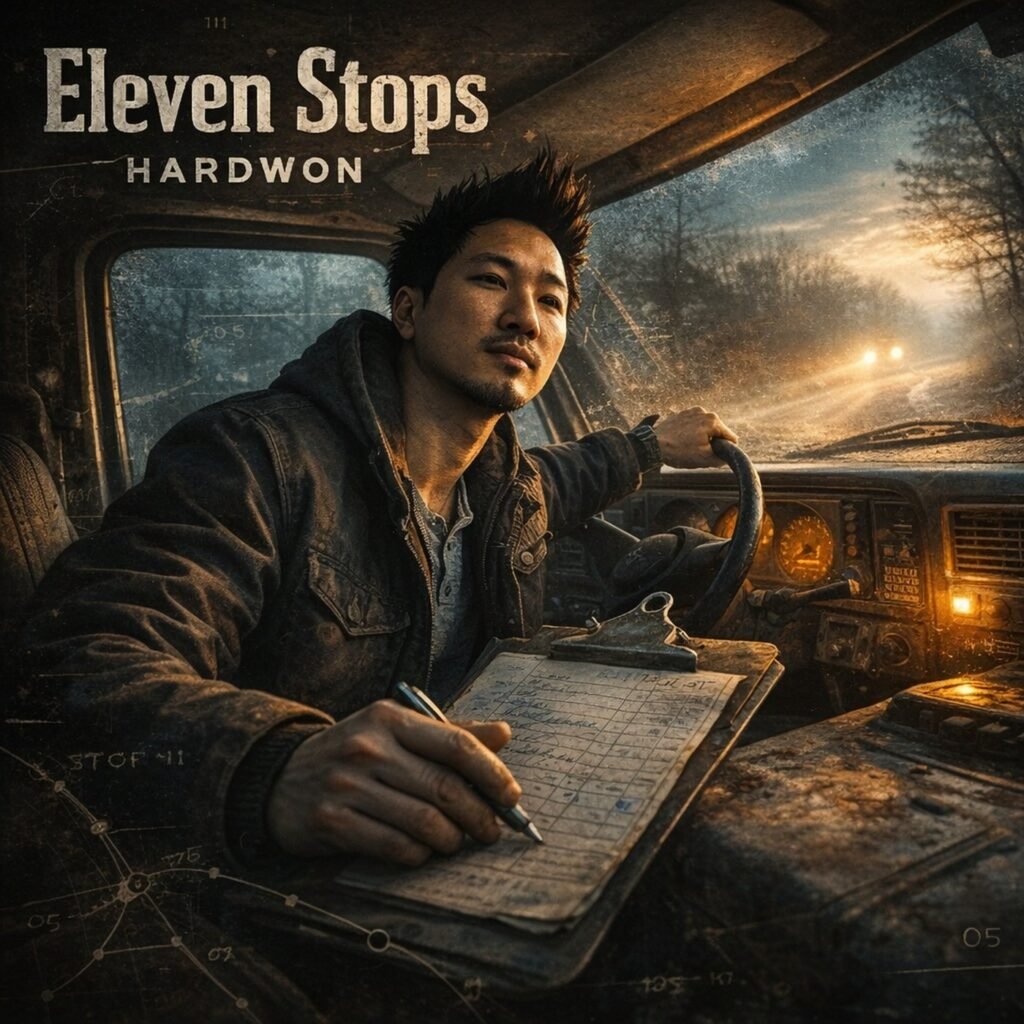
Open D tuning never lets the low end sleep. A tuned 808 breathes behind a fingerpicked resonator, and the road noise never cuts. That is the first fact of HARDWON’s Eleven Stops, and it is a mix decision before it is a metaphor. The record tunes the acoustic guitar to open D, lets the strings ring close enough to hear the room, and then places the low end at a distance that changes from stop to stop. On “March On The Hinges” the 808 sits far back, almost patient. On “Manifest On The Dashboard” it steps forward, stark and undecorated. The track order is geographic, stop one through eleven, but the deeper continuity is lower: tire hum and engine ambience crossfade under every seam, so the listener never leaves the cab.
Open D does more than signal rural space. It changes what the low end can say. Because the tonic stays open, a fingerpicked pattern can repeat without resolving too hard, and the 808 can breathe under it without fighting for the same frequencies. The arrangement leaves a pocket between the dry resonator and the distant bass, and HARDWON’s warm baritone lives inside that pocket. Verses stay close and dry, as if the delivery is being logged rather than performed. Choruses open into melody without leaving the cab.
The record’s first close-up is “March On The Hinges.” The resonator is recorded close with room noise, the 808 is far back, and the voice arrives in an unhurried conversational pocket. The key line, “First light hangs thin on the county road,” is not scenery; it is temperature. The twist in the story, leaving a box where the old dog used to sleep, is carried by the arrangement’s restraint. Nothing about the production announces grief. The engine hum continues underneath, and the routine goes on.
Nine Scheduled Minutes
The slowest stop on the album is not about pity. “Nine Scheduled Minutes” runs at a patient 070 to 084 beats per minute, and the 808 is sparse enough that the upright bass and long pedal steel sustains carry the weight. The song is the most sung on the record, and that choice matters: a full warm southern vocal, not a rap pocket, matches the patience of the scene. The key line, “Blue pen trembling on the receipt line,” lands without ornament because the detail is the whole portrait.
The arrangement supports the words by refusing to hurry them. With the low end pulled back, no beat pushes the next moment. Steel notes hang across the measure. The story’s twist, that Wes manages earlier stops to protect nine minutes for an eighty-one-year-old widow, appears not as proclamation but as space. The track has room to pause, and that room sounds like companionship scheduled into a workday. The sparse 808 is not cold; it is the same low end as elsewhere, just less interested in propulsion. That is the album’s argument: attention is a tempo choice.
The Verse Without Acoustic Warmth
Midway through the route, the acoustic guitar disappears from a verse. “Manifest On The Dashboard” strips back to a halftime 808, a stark bass line, and brushed percussive ticks. The minor key lands hard because there is no resonator, no dobro, no pedal steel to soften the arithmetic. HARDWON’s delivery turns flat and determined, with dense internal rhymes and zero anger, just the sound of a man doing his own math. The key line, “But land has a memory and weather has will,” names a force the spreadsheet cannot see.
But land has a memory and weather has will.
This is the album’s sharpest arrangement idea. The real instrument on Eleven Stops is what gets removed. Acoustic warmth is not absent because feeling has cooled. It is absent because the official map cannot hear the people along the route. When the fingerpicking and pedal steel return later, they feel earned, physical. The listener understands the warmth was doing structural work from the first track.
The Last Rep Drop
The record’s signature formal mechanism appears near the end. Four bars drop to a raw kick and a dry vocal before the final hook, a move HARDWON imports from gym rap and turns into something quieter. On “Footsteps In The Driveway” the drop removes every layer except the one that matters, and then the full-circle cooldown arrives. The acoustic guitar pattern from “March On The Hinges” reappears, a harmonica figure moves in transposed down a fourth, and the final sung passage sits close to a lullaby. The key phrase “Mmm… first fence, last light…” is not a punchline. It is the route resolving to its own origin.
The arrangement choices here contradict expectation. A lesser record would end big, with the low end swelling into triumph. This one ends warm and unadorned. The 808 steps back, the steel sustains, and the last image is a thermos of coffee at a farm gate as daylight fades. The route is the relationship, and the production makes that relationship audible by returning to the first harmonic material without demanding applause.
The Missing Four Stops
The repeated route is never an empty loop. The record makes that argument through small production decisions. “Gravel On The Hubcaps” builds its rhythmic fingerpicking to mimic the steady rotation of tires. “Wire On The Flatbed” supports a lower register with a brushed snare and an upright-feeling bass line, the physical labor of moving heavy wire translated into walking rhythm. “Own Tank Of Gas” relaxes the 808 under a rolling acoustic guitar and a first subtle harmonica, so the low end shifts from pressure to choice. When the paid route shrinks and the missing four stops become a Saturday routine, the music does not mourn. It steadies.
The album ends where it started, at the farm gate from stop one as daylight fails. Someone steps into the gravel driveway and offers a thermos of coffee. The final cooldown is not a bow. It is the sound of a route that has been kept whole, one unpaid mile at a time.