Album Story · November 3, 2026
Eleven Stops and the Weight of Nine Minutes

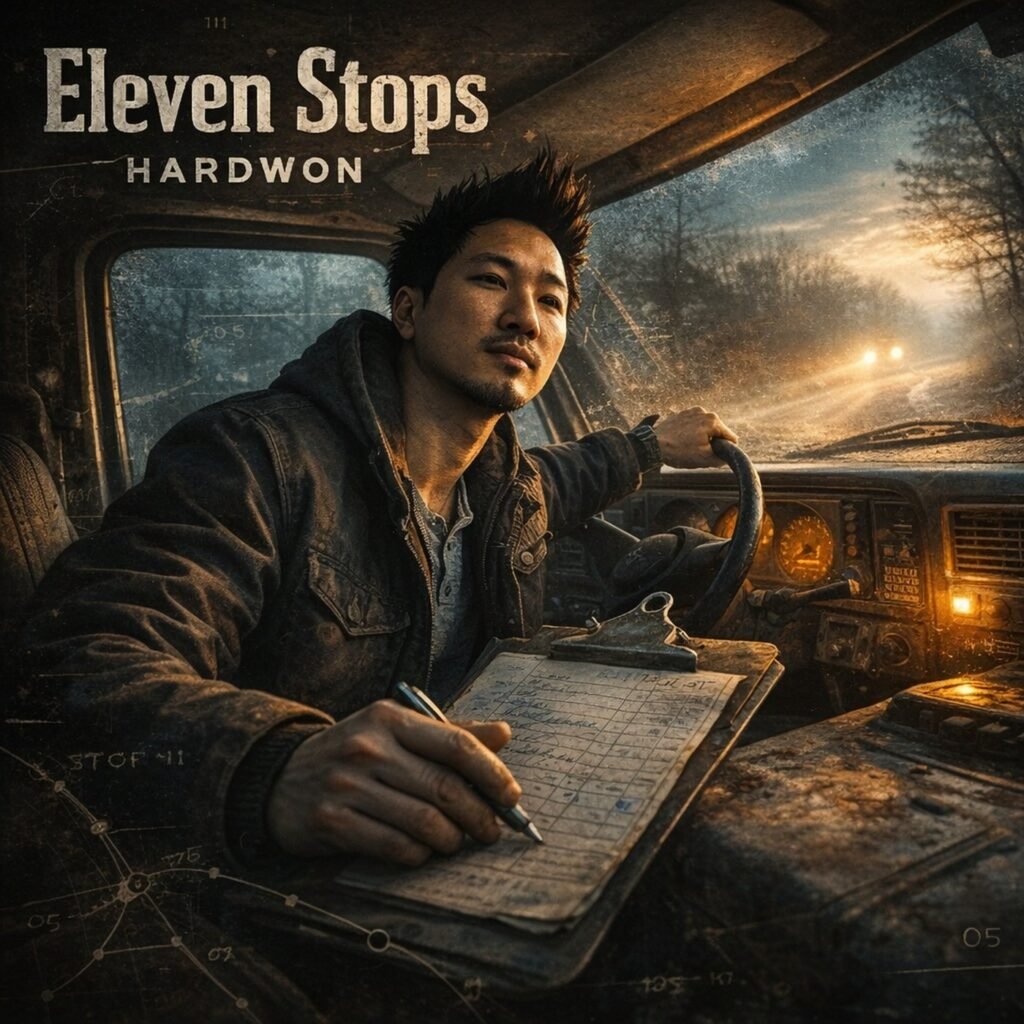
Five Forty-One
The cab still holds the cold from the last hour of dark, and the defroster has carved just enough clear glass to show the county road unspooling under the headlights. Eleven Stops by HARDWON lives in this hour, before the sun commits to the fence line. Wes has driven the same ninety-four miles in the same sequence for six years, and the first stop has not come out to meet him since March. “March On The Hinges” does not announce loneliness.
First light hangs thin on the county road,
The track gives close resonator guitar, room noise, and a baritone that sits near enough to catch the weight of each syllable. The narrator leaves the box exactly where the old dog used to sleep, not as a tribute, but because the routine still respects a grief nobody has named aloud. At stop two, “Pallet By The Wall” turns that working logic into a country-trap groove: a woody snare, a dobro stating the hook, and a foreman who signs with his left hand because his right shoulder no longer allows it.
Nine Minutes Banked
By stop three the light has moved from thin gray to September amber. “Timed For The Bell” is not sentiment. It is arithmetic. Wes drives five under for three miles so the student helper gets to meet him at recess, because the kid needs to carry a lightweight box of paper and feel useful. The production turns porch-stomp bright, claps and floor-tom stomp under a chantable chorus. Then he threads a mile-long driveway in “Gravel On The Hubcaps” without disturbing the ruts, because the homeowner rakes that driveway every morning for exercise. The song’s fingerpicking mimics the steady rotation of tires, and the multisyllabic rhymes mimic the calculation of careful steering. The clearest portrait sits at stop six. “Nine Scheduled Minutes” is a southern sung-rap ballad with long pedal steel and a sparse 808. The widow does not receive a rushed delivery. She receives a scheduled conversation, a blue pen trembling on the receipt line, and a man who has banked time by saving it in all the earlier stops. The record’s midpoint is not melodrama, it is a working definition of care. The song spends more time on a small envelope than most records spend on a plot.
Land Has A Memory
By stop seven the route meets the spreadsheet. The regional drop hands down the new consolidated paperwork, and the record turns minor. “Manifest On The Dashboard” strips the acoustic warmth out of the verse. Only halftime 808, stark bass, and brushed percussive ticks remain. The voice goes flat and determined, never angry. Dense internal rhymes do the arithmetic: finish the official run, then drive the missing four stops unpaid. The album does not let the change live only in lyric. The open D fingerpicking that tied the drive together thins into sparse heartbeat kicks in “Eyes On The Bootlaces”, where the narrator leaves parts for a former quarterback and signs the log himself so the man does not have to turn around and make eye contact. Then “Water Over The Culvert” turns the floor-tom stomp into splashing footfalls. The narrator could legally mark it undeliverable and save forty minutes, but he wades through the flooded road because he knows what is in the box. This is where the sound shows its architecture. The same instruments return, but the pressure changes. The 808 hits the downbeats harder, the dobro riff drives, the vocal pushes the pocket as if hauling weight. The constant cab noise matters. Engine and tire hum crossfade from one track into the next, so the record never pretends the drive is a clean soundtrack. By stop ten, on a Saturday in his own truck, the tone relaxes again. “Own Tank Of Gas” rolls with warm acoustic guitar, a relaxed 808, and the first subtle harmonica in the background. The narrator realizes the unpaid run is not sacrifice. It is the only way to keep owning the labor and the relationships the algorithm tried to erase.
First Fence, Last Light
Late afternoon drops long shadows through the yellow pine. “Last Gravel Turn” returns to ballad time, with sweeping pedal steel and an acoustic pattern that reuses the shape from “March On The Hinges”. The official route is finished, and the saved time should feel like a gift. Instead it feels empty without the people the route used to contain. Then the album closes its circle. “Footsteps In The Driveway” reuses the opening harmonic material and lets the harmonica figure return transposed down a fourth into an earned resolution. The narrator is back at the first farm gate. The person who had not come out since March finally steps onto the porch. No speech, no explanation, just a thermos of coffee. The final cooldown is nearly a lullaby, a warm baritone over an unadorned acoustic bed. It is not a victory. It is proof that showing up can become a place where someone finally steps out to meet the driver.