Liner Notes & Lore · November 2, 2026
The Low End Moves, the High End Holds

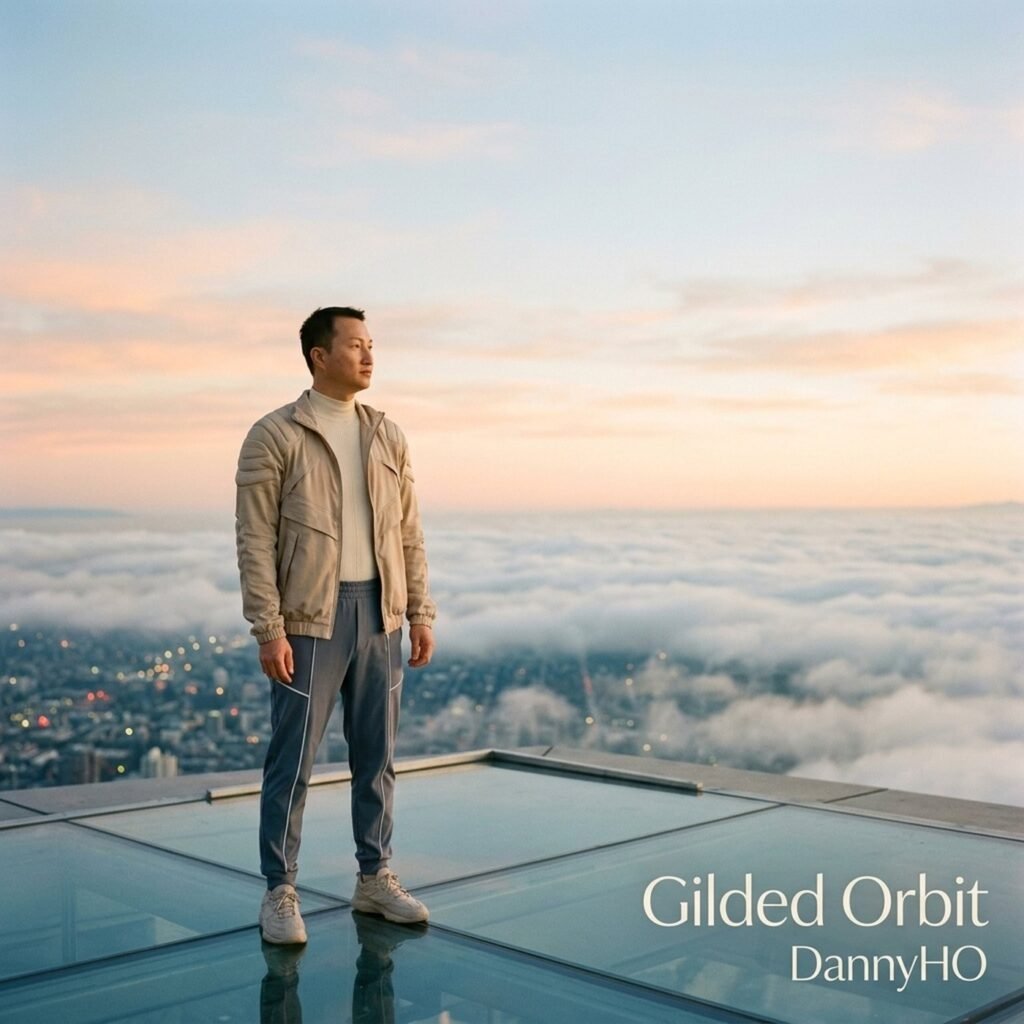
Before any lyric arrives, a jet engine is tuned into a chord. In “Vertical Silence,” the first sound of DannyHO’s Gilded Orbit is an analog drone pad modeled on a turbine and harmonized into Eb major. The low end arrives as warm sub-bass, the kick is a pristine four on the floor, and the drop never overwhelms the vocal. A glassy FM pluck sequence circles above the sub, while ice swirls and a seatbelt click supply small high-frequency events. The song stays sleek, never aggressive. That is the album’s first argument: ascent is not loud. The arrangement moves from tarmac ambience to a restrained verse, then a filter-lift pre-chorus and a euphoric chorus that still feels levitational rather than heavy. The half-time bridge is the moment the protagonist looks out the window and sees only weather. The twist in “Vertical Silence” is that he is not flying toward anything, only away from noise. The music supports this by returning to a drone outro instead of a fanfare. There is no final gate, no announcement. The jet engine hums and recedes.
The Door Is a Snare
The most repeated instrument on Gilded Orbit is not a synth or a string section. It is the sound of a luxury car door closing. In “Glass Dynasty,” a gated snare is layered with that heavy thunk, and a Moog sub-bass idles underneath like an engine in neutral. The hi-hats tick like a watch, the pads are high-passed until they feel like altitude, and the chorus spreads into plate reverb wide enough for a penthouse. The production does not use the car door as decoration; it places it inside the rhythmic grid. The same logic returns in “The Vulture Wears Armani,” where a deep rolling sub-bass behaves like a vehicle under the vocal and the percussion is formed from snaps and icy hats, with the car door closing as the deepest accent. In “Silk & Steel,” silk rustle, cufflink clicks, and the door close become micro-rhythms next to hi-hats that zip like a jacket. The idea hidden inside these choices is precise: status objects are not just present in the songs; they keep time. Every door close is a small exclusion, and the record grooves on that separation.
The Dry Voice Inside the Wet Drop
The vocal architecture does something quietly perverse. Verses are close-mic’d and dry, so the breath and mouth sounds sit near the listener. Drops open into long, wide reverbs while the lead vocal stays present. In “Gilded Hush,” the verse is intimate and nearly unadorned, then the chorus releases into reverb-drenched vocal chops. Champagne corks and the click of a lighter appear as percussion around a punchy kick, but the voice remains the most material object in the room. In “Glass Dynasty,” the verse is a lower-register whisper-sung close-mic before the chorus doubles wide. The result is a voice that feels close and unreachable at the same time. The listener can hear the texture of the singer’s mouth but cannot enter the space the chorus occupies. That is the bulletproof glass rendered in sound. “Ghost” pushes the same idea further: the beat sounds muffled, as if heard from behind tinted glass, and the vocal is breathy and vocoder-layered. The protagonist’s invisibility is not hidden in metaphor; it is in the filter, the reverb, and the distance between the dry lead and the wet backgrounds.
A Palace Made of Glass
Glass is everywhere on this record, but it never shatters until it is already under control. “Garden of Glass” pairs sharp staccato string ostinatos with crystalline synth melodies and a warm but aggressive sub-bass. The vocal is rhythmically tight and precise, and the side-chained drop keeps the strings from becoming chaotic. The message of the song is ruthless pruning, and the arrangement behaves like a blade with excellent posture. “Glass Throne” uses glass-shattering samples as percussion, yet they land inside the grid, tense but never messy. The high-pitched synths and risers generate anxiety, and the vocal builds toward a desperate cry. This is fragility worn as a crown. In “Carrara Heart,” the percussion turns cold and hollow, the piano sits in heavy reverb, and the vocal stays detached, almost robotic in places. The twist is that he wishes he could break but is too well-made. The arrangement agrees with him. It withholds distortion, withholds climax, withholds the mess he might want. The production is too polished to cry.
The Dividend at 86 BPM
The finale removes the door, the kick, and most of the glass. “Quiet Dividend” moves at a heartbeat-like 86 BPM in Bb major, built on soft felt piano, glassy pads, and bell-like arpeggios. Legato strings and textural brass swell but never blare. Percussion is reduced to breathy ticks, brushed pulses, and distant cinematic impacts. The vocal begins close-mic’d in the verses, then opens into airy harmonies and a serene falsetto in the outro. The low end is a warm sine sub-bass that gives weight without punch. This is the sound of wealth after it stops performing. The track resolves the album’s production thesis: control can eventually relax, and the real dividend is space. The car door does not close at the end. The high-altitude wind is what remains.