Liner Notes & Lore · November 6, 2026
IMMOYANG and the Grammar of Shared Breath
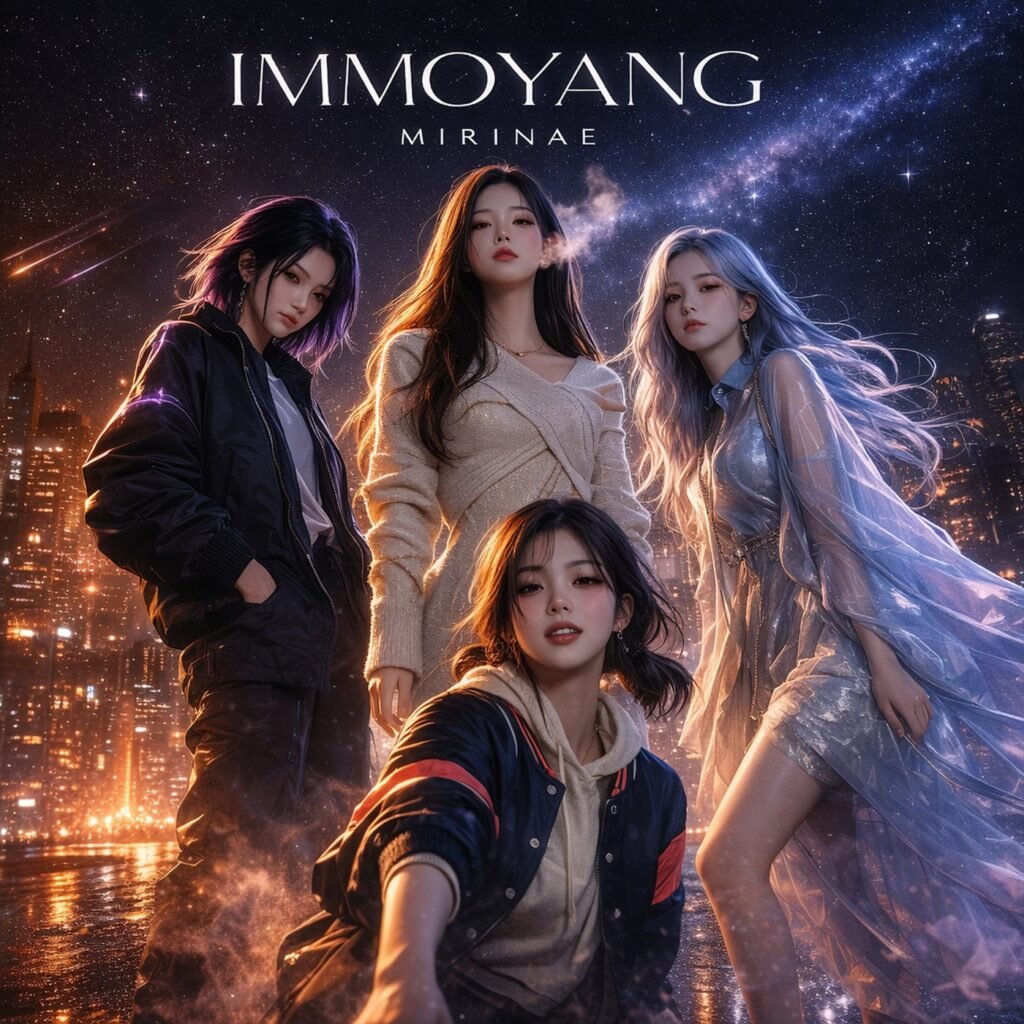
Under the 122 BPM kick of the title track, an acoustic guitar skips against the shuffle like a pebble thrown across wet asphalt. The sub-bass enters low enough to be felt in the ribs, never loud enough to announce itself. MIRINAE works in that uninsistent register throughout IMMOYANG. The mini-album treats volume as a kind of intimacy, building its loudest moments from stacked voices rather than stacked synthesizers.
The Mouth as a Time Signature
On “IMMOYANG (입모양),” the hook does not explain what the song means; it asks the lips to make the shape of the meaning.
짧게 끊어, 끝 받침 딱
That line turns the Korean batchim into a rhythmic event. The final consonant closes like a snare, short and hard. The arrangement obeys: a brisk UK garage shuffle leaves tiny gaps where the next syllable should be. The 122 BPM pulse does not build toward a festival drop. It subtracts, peeling the percussion away at the chorus until the voices and a warm sub-bass carry the momentum. Harin opens the verse in airy falsetto, Sori’s pre-chorus thickens with deliberate batchim, and the whole song behaves like a line distribution grid before it becomes a hook. This is not maximalist EDM. It is easy-listening pop with a dance floor hidden inside its consonants.
Two Paces, One Stride
The middle of the record holds a pair in tension: the inward catch and the outward step. “HESITATE : 멈칫” shapes silence as a full emotional gesture. The key lyric “꾹 닫힌 끝말, 짧게 끊긴 받침” closes the mouth around the edge of a confession. PluggnB production wraps a sluggish sub-bass under crisp hi-hats, and the beat stutters or drops out entirely for a fraction of a second. Harin’s falsetto floats above those gaps, so the voice and the rhythm section seem to argue: the voice wants to rise, the drums keep missing a step. That contradiction is the song’s argument. The hesitation is not a failure to speak; it is a more accurate speech.
“RIPPLE (윤슬)” moves from the single mouth to two bodies in step. The phrase “폭 좁은 구간은 한 줄로 통과” describes a narrow path forcing two walkers into one line. The arrangement matches with a punchy mid-tempo house beat and strummed acoustic guitars; clean electric licks open the air around the rhythm. Sori’s bouncy verses let the batchim hit like a heel on pavement, while Yuna’s belting arrives only when the song needs a wider space. No hands, no declaration, just identical strides in time.
The Shadow Below, the Sky Above
The same light that makes the sky legible also makes the ground legible. “SILHOUETTE : 서로의 곁” and “STARFALL (별무무리)” split that light into a private game and a public map. The first keeps its eyes down.
닿을 듯 말 듯, 그림자 술래
That line names a shadow tag, an almost-touch. Deep house gives the track a warm low-mid center, a four-on-the-floor kick, and muted jazzy chord stabs with very little high-end clutter. Nari’s low chant anchors the ground while Yuna’s high contrast cuts over it. The humans above stay shy; their shadows meet without permission.
“STARFALL (별무무리)” lifts the gaze from pavement to sky. The four-part vocal stack is the album’s widest arrangement, built over shimmering pads and the signature house pulse. The line “턱, 턱, 밑창 닿는 단단한 박자” turns footsteps into the star map. The twist is not astrological. The stars did not align anything; the walkers aligned their paths until the sky looked like a map of their soles. The arrangement supports that refusal by keeping the build organic: more voices, more breath, no drop that arrives from outside the song’s own motion.
The Hum Left in the Cold
The recurring wordless “Starlight Tag,” that intimate “ah-ah” hum at post-chorus seams, is not a garnish. It is the album’s structural hinge. When language stalls, when the hook has done its work, the four voices hum in unison and the record passes from one section to the next without a single new word. This is the idea the six tracks have been building: the physical vocal gesture is already a form of understanding. The mouth needs no translation.
“LINGER : 남은 숨” closes the sequence by slowing the pulse to a heartbeat. The key phrase “갈림길 앞에서 걸음을 늦춰” catches a walker slowing at a fork, not yet choosing. The production strips away everything ornamental: warm Rhodes piano, very close dry voices, and a deeply muffled four-on-the-floor kick. Yuna holds back her belting for a controlled, tear-thin register. The song does not resolve into a soaring ballad. It exhales. The final sound is the same wordless hum, now thinned to a warmth in cold air.
When the bass decays, the only instrument left is a mouth held open against the night. The record has not turned the city into a constellation. It has simply noticed that walking under one, mouthing the same vowel, leaves a warmth that language never arrived in time to explain.