Liner Notes & Lore · October 26, 2026
The Grip That Becomes a Doorway
1. THE PROVOCATION
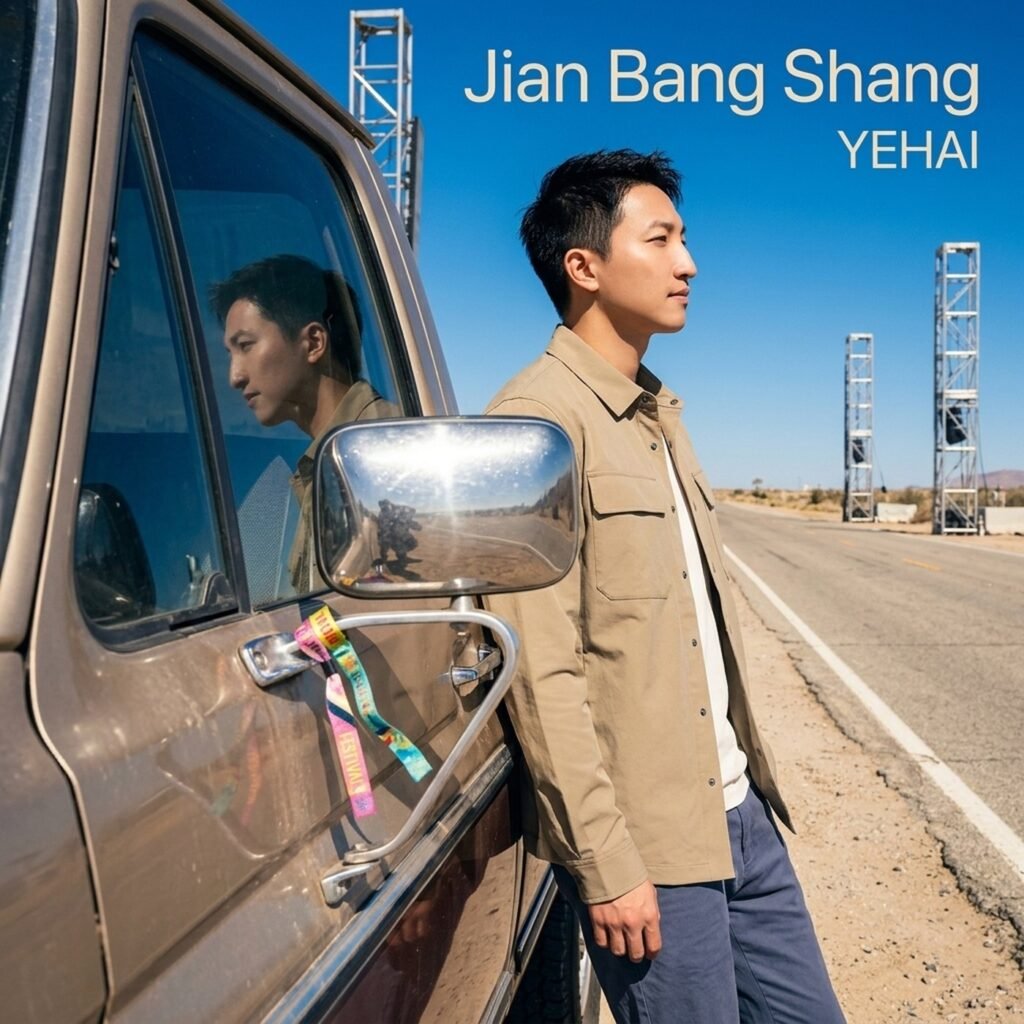
This record opens with a promise made at a kitchen table, before calendars are checked. Cheng says yes to his niece because it is the first time she has asked for something this large. His agreement is not generosity exactly; it is the involuntary reflex of someone who realizes he has become the person a teenager turns to. YEHAI’s Jian Bang Shang builds its philosophy from that reflex. The album argues that adulthood stops being a waiting room for youth’s return and becomes instead a practice of amplifying someone else’s first encounter with the vast world. By the time the mainstage lights ignite, Cheng is no longer chaperoning. He is being reawakened through the precise act of making her reawakening possible.
2. SYMBOLS & SUBTEXT
“Ni Qu Wo Jiu Qu” plants the central metaphor in its key lyric: “你的第一次,也推开我的窗” (your first time also opens my window). The window is his own dormant youth, opened not by his longing but by her asking. In “Ti Ni Na Zhao Wai Tao,” the jacket he holds is not a burden. The fabric becomes an anchor, a physical purpose that lets him enjoy the music without performing to it. The twist in “Si Shi Fen Zhong De Jian Ge” is sharper: when they are separated for forty minutes, his fear is not that the crowd will harm her. It is the sudden, vertiginous recognition that she does not need him to survive there. The song is less about panic than about the preparatory ache of watching someone grow.
Then “Wo Men Chang Le Tong Yi Ju” resolves the generational span with devastating economy. He did not teach her the song. She found it on her own, a track he loved twenty years prior. The transmission was not handed down; it arrived independently, twice. That is the album’s quietest miracle: shared love need not be inherited to be shared.
3. SONIC ARCHITECTURE
The entire record is governed by a dual-register mandate. Every chorus arranges a grounded adult tenor against a bright, high-register line one octave above, engineered so an untrained adult and a teenager can sing in unison without transposition. This is not a mixing trick; it is the story made audible. The instrumentation is warm analog synths, driving four-on-the-floor kicks, and clear sub-bass that mimics the physical voltage of live music. “Ba Nian Mei Jin Ren Qun” lets the kick feel like bass in the earth. “Gen Zhe Ren Chao Tui Chang” muffles that kick until it is a heartbeat slowing. The single tonal modulation, upward by one degree at the final chorus, lands exactly where the emotional lift demands it. And “Xie Zi Fang Zai Xuan Guan” strips everything away, the kick gone entirely, until a solitary resonant chord and a naked voice remain in a hallway.
4. THE PERSPECTIVE SHIFT
This album challenges the listener to stop thinking of caregiving as sacrifice. For adults aged 30 to 45, it reframes enabling the next generation’s first experiences as generative, not diminishing. Cheng does not reclaim his youth by jumping the barrier himself; he reclaims it by gripping the barrier so she can stand on it. For younger listeners, the record quietly validates that their first times carry weight for the people who love them. The concluding realization is delivered without melancholy: “你会去更远,我会记得今晚” (you will go further, I will remember tonight). By making himself obsolete for the next festival, Cheng completes the loop. The drive home is silent only because the radio would be redundant. Her breathing in the passenger seat is the only soundtrack the moment requires. That is the album’s final proposition: the best first time you can have at forty may be the one you gave away.