Liner Notes & Lore · September 5, 2026
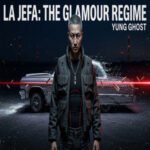
LA JEFA: THE GLAMOUR REGIME, Notes From the Throne Room
1. THE PROVOCATION
What happens when the person kept outside the room refuses to ask for entry? LA JEFA: THE GLAMOUR REGIME answers with posture, pressure, and a stare held too long. YUNG GHOST stages authority not as polite arrival, but as a confrontation with every gaze that has measured worth through inheritance, invitation, or etiquette. The ballroom is both sanctuary and tribunal. Velvet ropes become a test of who believes they can decide who belongs.
This record understands glamour as armor with a pulse. Its protagonist carries dust into mahogany halls, then makes the room answer to that dust. The transformation is deliberately excessive, camp sharpened into menace. Yet beneath the coronation lives a harder question: once you seize power from those who hoarded it, what do you owe the people still standing outside?
2. SYMBOLS & SUBTEXT
In “Trono,” trembling wine glasses announce a reversal of power before a word is spoken. The heavy doors and silver platter turn aristocratic ritual against itself. The narrator is not seeking acceptance from the old court. He arrives to expose how fragile its composure has always been.
“Seda” makes fabric a record of survival. Its crimson silk refuses the elite fantasy that luxury must be clean, untouched, and detached from consequence. Beauty here bears evidence. It is worn not to conceal a past, but to force that past into full view.
“Couture” offers the album’s deepest counterargument to purchased status. “Mi abuela bordó dragones” makes ancestral labor the true jewel of the room. The garment’s value cannot be reduced to a price, because it holds hands, memory, defiance, and care. That idea reaches its fullest emotional weight in “Matriarca,” where supremacy is redefined through the protective legacy of a grandmother rather than the borrowed language of a jefe.
3. SONIC ARCHITECTURE
The album builds its palace from organic weight. Dembow patterns and Jersey Club force meet deep 808s, their long releases made to breathe beneath punchy kicks. Reversed 12-string corrido guitar figures bloom in plate reverb, like old wood and distant prayer pulled backward through a chandeliered hall. Congas, shakers, brass, orchestral impacts, and acoustic guitar rhythms preserve a tactile, hand-played grain even when the low end strikes with ruthless force.
Silence is a weapon throughout the record. Before choruses, the floor vanishes. Then the beat returns broad and physical, demanding a body answer it. Vocally, YUNG GHOST moves from close, taunting breaths to chest-deep commands, from fast Spanglish precision to a baritone calm that feels more dangerous than a shout. By “Ópalo,” the voice allows ache into the regime. By “Matriarca,” it no longer needs to prove itself.
4. THE PERSPECTIVE SHIFT
For ballroom devotees, street-fashion youth, and anyone who has made a persona to survive a hostile room, this album insists that alienation can become ceremony. Its glamour is not escapism. It is a method of reclaiming the right to be seen on one’s own terms.
The final revelation is that domination alone is too small a dream. “Centro” returns the stolen throne to the barrio as warmth and use, while “Matriarca” accepts the burden of care that comes with being central. The listener leaves with a different image of power: not sterile prestige, but gold touched by work, velvet carrying history, and a crown that protects as fiercely as it commands.