Album Story · November 7, 2026
A Watch, a Charger, a Drive at Dawn

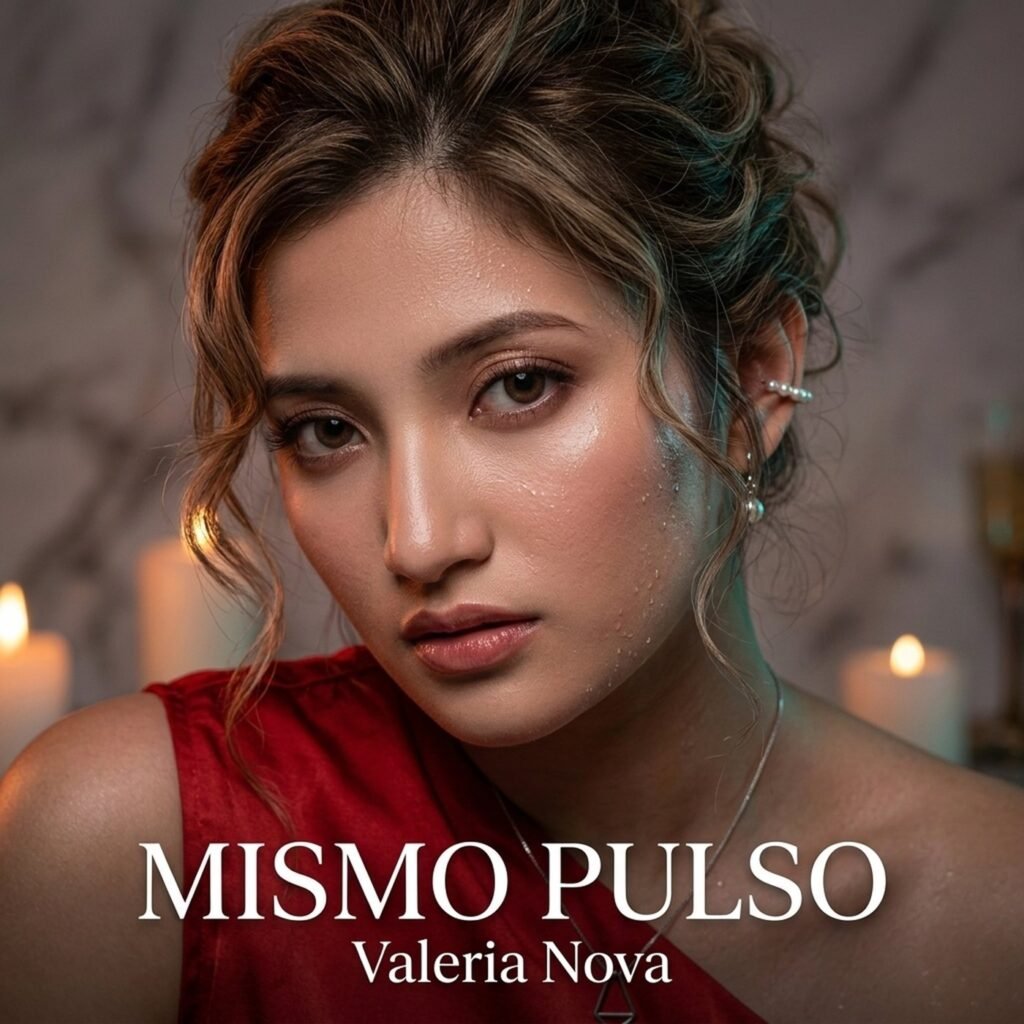
The second hand on Julián’s Patek ticks against Camila’s skin while he sleeps. That image arrives late on MISMO PULSO, the album by Valeria Nova that spends a single night arguing with itself about whether knowing better changes anything. It starts with a message.
The First Claim Is Control
At 11:40 PM, “VÉRTIGO LATE” begins as a small detonation. The lyric “Shadows resting heavy on the glass” sits over a heartbeat sub kick and Rhodes chords that decay into silence. Camila does not answer because she misses him. She answers because the perfect stillness of three months, that clean act inside a chaotic history, has become unbearable. The record’s first claim sounds like self-possession. She can re-enter the old gravity without falling.
“SEDA CRUDA” tests that claim in a bedroom. Forty minutes of dressing become a negotiation with armor. The lyric “She knows every weakness, never points it out” arrives in a low alto, slightly behind the beat, while the first Bachata Medianoche requinto line threads through soft brushed güira and rolling sub-bass. She is not trying to impress him. She is trying to intimidate him, to prove she is out of his league even while walking toward him. The album keeps insisting that intention is a form of power.
“MADRUGADA VOGUE” lets the city breathe. “Cada semáforo en ámbar me mece” floats over bongó patterns that mimic tires and a muted Rhodes. She takes the longest route to the bar, not out of fear, but to stay in motion. Control here is not a lie. It is a rhythm.
“HIELO DRY” brings the first public test. One empty chair, one held gaze. The beat is mid-tempo Dembow at 112 BPM, heavy 808 hits kept on a short leash, staccato Spanglish used as a defensive weapon. Then the twist lands quietly. They both order each other’s drinks by accident. The record’s argument bends: habit survives the silence that willpower built.
The Elevator Calls the Bluff
The second movement strips the politeness away. “ESPEJO BLIND” traps the two of them in a mirrored elevator, and the entire conversation happens in reflections. The requinto is solitary and reverb-drenched, the güira barely a scrape, the vocal so close-mic’d that every breath before a phrase becomes audible. The song contradicts every civil line from the bar without speaking a single one.
“PIEL CARMÍN” turns that contradiction physical. The hotel room door clicks shut and tenderness is not what enters. The bongó is hard and fast, the sub-bass thick and distorted, the vocal stacked into controlled grit. The intimacy is aggressive, almost punitive, as if three months of silence are being repaid in pressure. The album refuses to call this victory or collapse. It treats the body as diagnostic data.
Then “CUATRO AM” removes nearly every sound. Percussion evaporates. A submerged bassline and warm Rhodes hold the room. Julián’s confession arrives without tears or argument, and the lyric “Lo que siempre estuvo en tu espalda” lands not as a new beginning but as final evidence.
Lo que siempre estuvo en tu espalda
The song does the opposite of rekindling hope. It extinguishes it, giving Camila the exact closure she did not know she required. This is where the album’s early claim of control stops being a performance. She listens, absorbs, and does not react.
What the Production Admits
The sound of MISMO PULSO is its own argument. Every track stays locked at 112 BPM, but the pulse never repeats emotionally. One custom requinto tone, restrained güira and bongó positioning, warm Rhodes beds, glassy submerged pads, and deep controlled sub-bass carry the whole record. There are no accordion sweeps, no brass, no ornamental bachata runs. Dynamics come from negative space and vocal distance. A whisper in “ESPEJO BLIND” does more than a volume surge could.
The same tempo becomes grinding Dembow in “HIELO DRY”, a near silent R&B pulse in “CUATRO AM”, and something else entirely by the end. Vocal texture maps the arc: conversational in “VÉRTIGO LATE”, detached in “SEDA CRUDA”, sharp in “HIELO DRY”, whispered in “ESPEJO BLIND”, raw and dry in “CUATRO AM”. The record sounds less like a genre exercise and more like one nervous system tracked through the night.
The Answer Runs on Her Own Time
The final three tracks settle the argument in a way that does not reward either side. “SOMBRA PATEK” puts Camila in the dark, awake next to him, wearing his expensive watch. A mechanical tick becomes the percussion. She is not keeping a romantic token. She is timing her exit. The lyric “Every late night left a mark” moves through synth pads that rise and fall like breath, while her vocal stays icy and precise.
“SILENCIO GHOST” follows her through the dark room. The requinto descends, the bongó plays a muffled pattern, and ghost harmonies surround a lead voice that sounds already gone. She leaves her own phone charger behind, not in panic, but as a deliberate signature. The gesture says she left with intention, not fear.
The only Cumbia on the album, “ALBA DRIVE”, releases the tension into an elastic groove. The sun arrives, and Camila turns the radio up because her mind is finally quiet. Her voice lifts full-throated and bright. The closing line, “No queda nada, no shadows in here”, is not a victory march. It is the sound of someone moving under her own momentum, with no need to rewrite the night.