Album Story · November 16, 2026
The Door Girl Steps Into Her Own Name

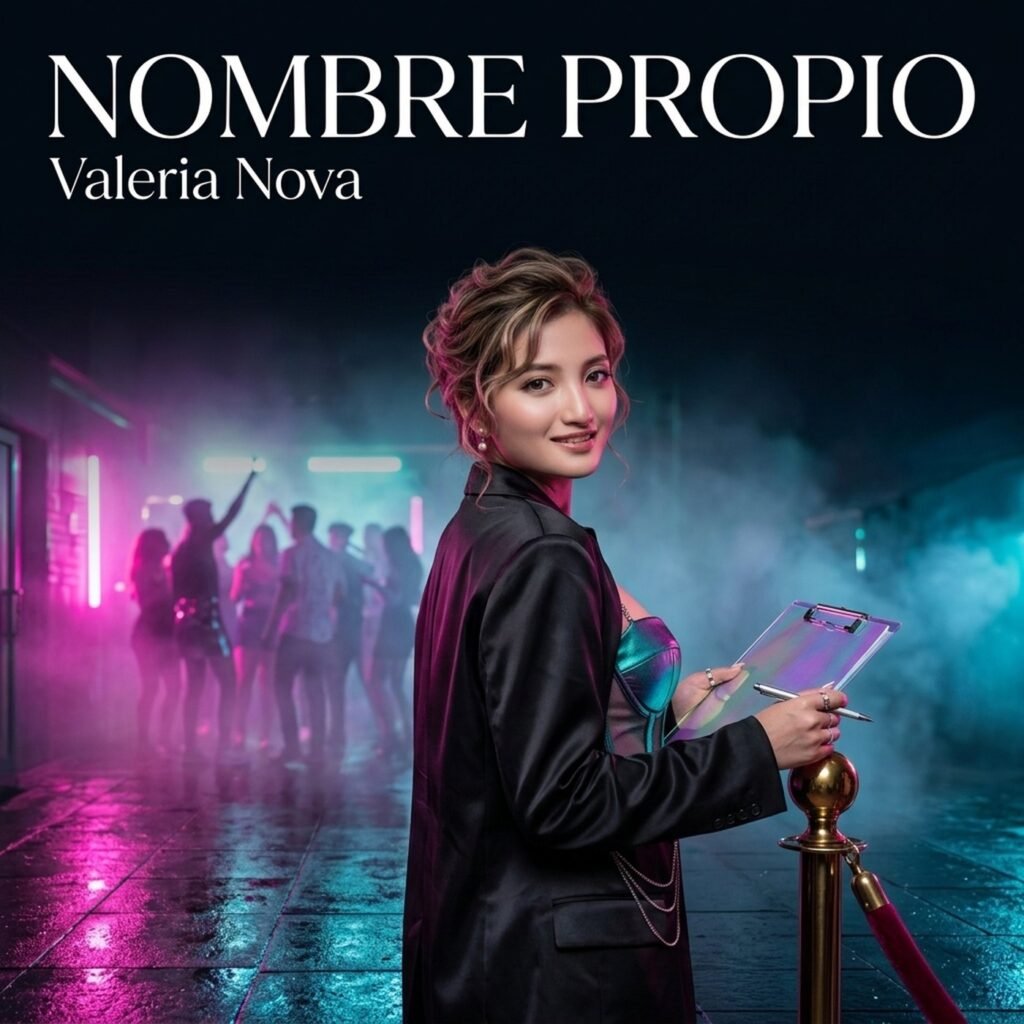
Nobody remembers the girl’s name until the stamp hits the back of their hand. The flattery ends there. The person who called her “prima” thirty seconds earlier turns toward the bass and disappears into a room full of people who all look, from behind, like somebody she should know. Valeria Nova builds NOMBRE PROPIO inside that precise, ordinary forgetting. Over twelve tracks, she traces a single summer at the entrance of an open-air venue, where a clipboard and a heavy chain make her the most visible person nobody sees.
Act One: The Door and Its Small Tyrannies
The record opens bright and wry, not broken. “LA CADENA” has a bouncing güiro and clean, muted guitar plucks, the sound of someone enjoying the smallest possible authority. In the pre-chorus the vocal turns conversational, almost spoken, smiling through the teeth. The twist lives in the lyric and the arrangement: she controls the heavy chain that blocks the door, but a deep modern kick arrives in the chorus to remind the room that the actual lock is not hers. Then “DERECHO DE ADMISIÓN” turns the transaction into physical velocity. At 98 beats per minute, the reggaeton grid is bouncy but submerged, wavy synth pads muffled like music heard through a wall, and Valeria’s vocal is cadence-driven, cutting through the low end. A stranger runs the usual script: You say, “Valeria, prima, remember me?” The second the stamp hits, he forgets her. That is the first turning point, from the comedy of minor power toward the cost of being treated as equipment. “TIZA Y CARTÓN” closes the act with a skeletal cumbia pulse, a filtered güiro, and a lower, breath-close vocal. She knows every face and no one looks her in the eye. The insider-outsider contradiction arrives not as a lyric alone but as the thinning space around the chant.
Act Two: The Polite Goodnight
The middle of the record dims. “BUENAS NOCHES” uses bachata medianoche, an interior pause with deep controlled bass and intimate guitar figures that feel like a quiet argument. The vocal is whispered and fragile, so close to the microphone that the breath becomes texture. If the man she had circled for two years had ignored her, she could believe he felt guilt. Instead he says goodnight with the polite carelessness reserved for staff, and the proof of her irrelevance is his comfort.
“no porque en tu memoria quedara una marca.”
“TERCERA PERSONA” widens the frame into cinematic Latin pop, warm piano and polite percussion, a big chorus held back enough to sound like distance. She understands she is not the director of these summer movies; she is not even in the cast. “OCHO HORAS” drags the cumbia tempo slightly, the güiro heavier, the guitar picking like a ticking clock. The hardest part is not the shift, the standing, the floor. It is the silence when the music stops. Then “EL CONTRATO” snaps the spell with dembow energy, sharp snares and a bouncing low end. The manager hands her a renewal with her last name misspelled. The line Y siempre el mismo cuento ordinario lands as a laugh with teeth. This is the second turning point: the safety of the door has become a lie she can no longer sign.
What the Güiro Carries
No guest voices enter this record, and no accordion softens its edges. A single güiro and hand-percussion pairing works as the spine across all twelve tracks, while the bass guitar behaves like a second melody instead of low-end furniture. In “LA CADENA” that bass is light and conversational; in “EL CONTRATO” it becomes a bouncing, unrelenting pressure; by “PULSO RÚSTICO” it drops away almost completely, leaving acoustic guitar, warm melodic bass, and a single piece of hollow wood. The vocal choices shift with the season. Valeria moves from wry, half-smiling delivery in the early tracks to an unvarnished, close, nearly cracking register on “PULSO RÚSTICO”, and then to the clear, bright, self-assured center of “NOMBRE PROPIO”. The production keeps the texture honest, not polished into a blur. That consistency is the point. The same güiro that once felt like a toy of authority slowly becomes the sound of her own pulse, the record’s witness without a guest list.
Act Three: The Queue, the Floor, the Quiet After
The final movement begins in retreat. “PULSO RÚSTICO” strips everything down to an acoustic guitar, warm bass, and a prominently mixed hollow wood. The vocal sits so close it almost cracks, and the loudest revelation of the summer arrives in total silence. In “LA ESPERA” the production swells back as dark, tension-building reggaeton, sub-bass throbbing like a heartbeat. She takes the night off and waits in her own line for an hour, though a staff privilege could have walked her straight through. The anticipation matters more than the entrance. Then “NOMBRE PROPIO” lands as the centerpiece, expansive and bright, with a crisp güiro, a punchy modern kick, and a bassline that is triumphant without aggression. The title track does not explode into glory. The lyric Me dio risa tanta ceremonia: frames the moment as almost comic: crossing the threshold feels normal, just a room with music, and that normalcy is the reward. “PISTA ABIERTA” lets the communal release happen on the floor, sweaty and ordinary, hand percussion and warm bass counterpoint rising into wide melodic choruses. Group responses flicker behind her voice, not as a choir but as other bodies choosing the same room. Finally, “MANOS LIMPIAS” walks away at closing time. The güiro softens to a heartbeat, the guitar lines ring clean, and the bass sits gently in the mix. She leaves the party with nothing in her hands. The empty space feels heavier and better than any clipboard.