Liner Notes & Lore · November 6, 2026
The Bottom End as Discipline in KAYA’s ПОЛНАЯ ВЕРСИЯ
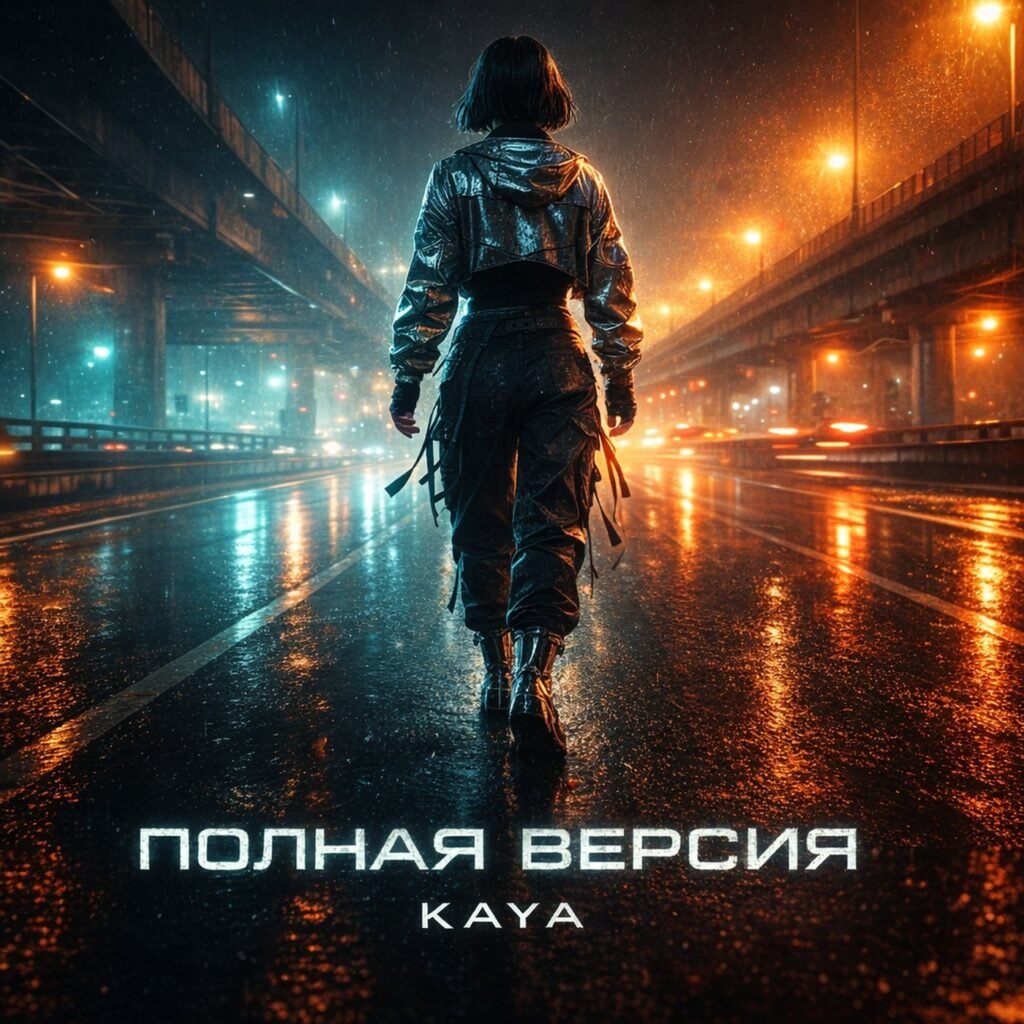
At 122 beats per minute, the kick in “третье транспортное” locks into place like a turn signal left on in an empty lane. The low end arrives before the voice does, a cold mechanized pulse that never reaches for the listener. That discipline defines KAYA’s ПОЛНАЯ ВЕРСИЯ. The record obeys a strict envelope: 110 to 124 BPM, never faster. It refuses slap-house plucks, cavernous drops, vocal chops, and any English phrase a listener might use as a handle. Each of its nine tracks opens with a long instrumental groove introduction, sixty to ninety seconds before the first sung line, and each contains only ten to fourteen vocal lines, no more than nine words per line. The space between phrases is wide enough to stand in. The music is not about heartbreak first. It is about the act of cutting, and what the bottom end preserves when the edit is refused.
The Kick at 122
In “третье транспортное,” the track’s Hijaz-scale synth motif appears only in the second minute, after the voice has already delivered its lines. She sings, “Я не меняю волну.” The line means she does not change the station. The arrangement proves the statement by continuing the out-chorus to its final second without interruption. The hard-panned vocal doubles sit so far apart they feel like two versions of the same thought, while the sub-bass stays broad and low, and the open hats keep their metallic edge. A faint car-interior texture sits behind everything, a cabin that never fully silences. The hardest part of the drive is not the memory of the breakup. It is the physical difficulty of letting three minutes of instrumental out-chorus play without touching the frequency. The kick at 122 BPM is not a heartbeat. It is a locked door that opens only at the speed of patience. A Hijaz hook lands once, then leaves the rhythm to carry the meaning.
The Silence Has Mass
Красная кнопка остаётся нетронутой.
“сорок минут” moves faster, 124 BPM, but its arrangement stays sparse. The 4/4 kick drives hard, and the Hijaz hook is carried exclusively by hard-panned vocal doubles rather than a synthesizer. Subtle dial-tone frequencies sit behind the voice. The red button remains untouched. The close-mic vocal is extremely breathy, with a proximity effect so severe it sounds like the voice is inside the ear. Then the twist arrives: the screen locks to black, leaving only the audio connection. The production understands the line better than the words. A dark screen is not a release; it removes the last visual escape. With no drop to land on, the track’s high kinetic energy becomes a held breath. The silence grows heavier, not emptier. Here the record shows its structural law. The wide spaces between phrases are not pauses. They are the only place where what is unfiltered can continue.
The Slowest Permission
“остывший чайник” is the album’s slowest point at 110 BPM. The percussion steps back, leaving a heavy rolling sub-bass and sparse metallic Foley: a switch, a kettle, the small machinery of an apartment at night. “Пар редеет над белым носиком.” The steam thins above the white spout. The vocal is conversational, unhurried, with massive gaps between lines and breath fully audible. The twist concerns not an argument but the respect of letting silence run its full course before the truth is spoken. The arrangement supports that by refusing to fill the gap. The sub-bass does not rise to signal drama. The metallic sounds do not repeat on a hook. They simply occur, like ordinary objects in a room where something honest is about to surface. This is the record’s slowest permission: the listener is not allowed to escape the pause.
Maintenance Light
“верхний свет” pushes 124 BPM again, but the frame is expansive instead of sparse. Swollen sidechain reverb creates a wide room, and a high-voltage oscillating synth carries the Hijaz melody. The vocal stays cold and detached, with high notes that cut through the reverb like a fluorescent tube. “Я остаюсь, пока свет не включится.” She stays until the light turns on. The twist reworks that light. It does not humiliate. It strips the room back to itself. The arrangement follows the same logic: after the hook, the track tightens drastically, removing haze until the reverb feels disciplined rather than dreamy. What remains is not a drop. It is clarity. The record’s quiet argument sits in that shift. Long spaces are not emptiness. They are where the body catches up with the edited version, and where the edited version finally stops pretending to be the whole.
The Hanger and the Dawn
The smallest gesture arrives at 122 BPM in “крючок у двери.” The snare and claps mimic the wooden click of a hanger. The sub-bass is focused and punchy. The Hijaz hook is minimal, played on a short-decay pluck. She sings, “Я вешаю её назад.” The twist is not rage. The ultimate sign of moving on is the quiet, polite act of fixing a dropped hanger before closing the door forever. The arrangement makes the gesture legible by turning hard Russian consonant clusters into percussive hooks, staccato and synchronized with the claps. No swelling pads, no emotional release. Just the click, the weight, the door.
Then “утренний бордюр” drops to 114 BPM and stretches for seven minutes. The percussive pressure strips down to bare, radiant waveforms and lingering sub-frequencies. The Hijaz hook moves into a major register. The vocal is soft, expansive, unhurried. “Я еду, полная версия себя.” The album ends where it began, in the car, but the claustrophobia has become scale. The same highway is now open. The bottom end still rolls. The difference is not speed. It is the willingness to let the last waveform decay without reaching for the dial.
The record’s hidden subject is not the former partner, the city, or even the grief. It is the false economy of the short version. Every skipped outro is a small refusal to inhabit the full length of a feeling. The album turns that refusal against itself by removing the usual rewards: no chorus to land on, no drop to post, no English phrase to caption. What remains is a slower, heavier form of pleasure. The low end does not narrate. It waits. In the final seconds, the car moves into wet asphalt, the sub-bass decays like the city exhaling, and she does not turn it off.