Liner Notes & Lore · October 24, 2026
The Raised Fourth: Relearning the Upward Resolution

THE PROVOCATION
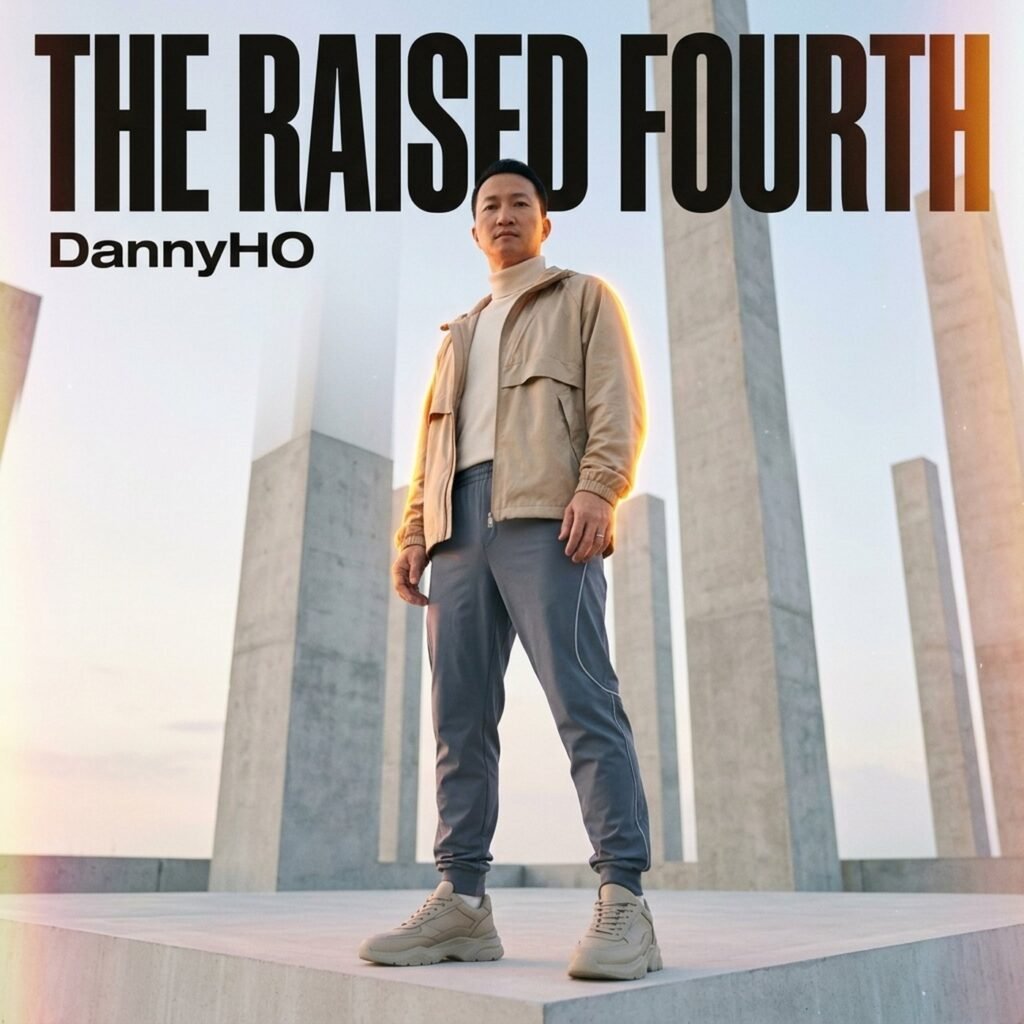
What happens when a brain spent two decades scoring catastrophe is ordered to stop? DannyHO’s The Raised Fourth begins with a medical mandate: no more minor keys, no more tragic resolutions. The composer, burned out from disaster documentaries, discovers he has physically forgotten how to write a melody that resolves upward. The album is not a celebration of natural optimism. It is a rigorous reconstruction of joy, treating euphoria as a technical discipline. The raised fourth interval becomes a ladder out of the dark, a harmonic tool that forces brightness without false cheer. Hope can be systematically relearned, one interval at a time.
SYMBOLS & SUBTEXT
Three tracks reveal the hidden work. In “Wake Up (See The Daylight)”, the lyrics describe a perfect sunrise, but the vocal delivery sounds like a plea for survival. The man is not greeting the morning; he is begging the light to let him through the door. His happy song is a hostage negotiation with dawn. “Give Me (The Open Sky)” sounds like an argument with a stubborn lover. Actually, he is arguing with the song itself. The lyric “Watch the shadow break and lose its hold” becomes a command to the melody, not to a person. The polyrhythmic percussion fights the four-on-the-floor kick, mirroring the tug between falling back and stretching upward. In “Tell Me The Truth (No More Rain)”, the truth he begs for is not a romantic confession. It is the unfiltered honesty of a nine-year-old studio visitor who says his music “sounds like the answer is always no.” That observation triggers the turning point. Rain on window glass becomes a symbol for tears he never allowed himself; now he asks for no more rain.
SONIC ARCHITECTURE
The production enforces zero minor-key tonic resolutions, no minor-ninth pads, no detuned sad supersaws. Tension comes from polyrhythms, syncopation, octave shifts, and spatial silence. The opening track uses brittle clinical FM plucks with zero reverb and a perfectly quantized kick that feels robotic. “Wait For The Dawn (Just Hold On)” strips away drums, leaving an acoustic guitar, a soft shaker, and a breathy pad, letting the raised fourth hang in empty air. Warmth returns in “Walk With Me (Through The Trees)” with a thick analog bassline, layered handclaps, and wide open acoustic chords. The vocals evolve from a clipped, breathless Y2K tenor to a massive five-part unison on “The Answer Is Yes (Forever)”. That final track plays the raised fourth with an entire synth brass section, turning a children’s science program theme into a stadium-sized proclamation of life.
THE PERSPECTIVE SHIFT
For urban professionals, endurance athletes, and creative builders who filter melancholy from their queues, this album reframes optimism as a skill, not a personality trait. The journey from strained, brittle cheer to unguarded radiance shows that real joy does not require denying darkness. It requires learning to resolve upward even after years of composing disaster. The final modulation in “Open Your Eyes (To The Radiance)” feels like physical liftoff, not because it ignores the past, but because it has rebuilt the muscle to rise. Listening to The Raised Fourth is a masterclass in resilience: you can forget how to be happy, and you can remember again.